
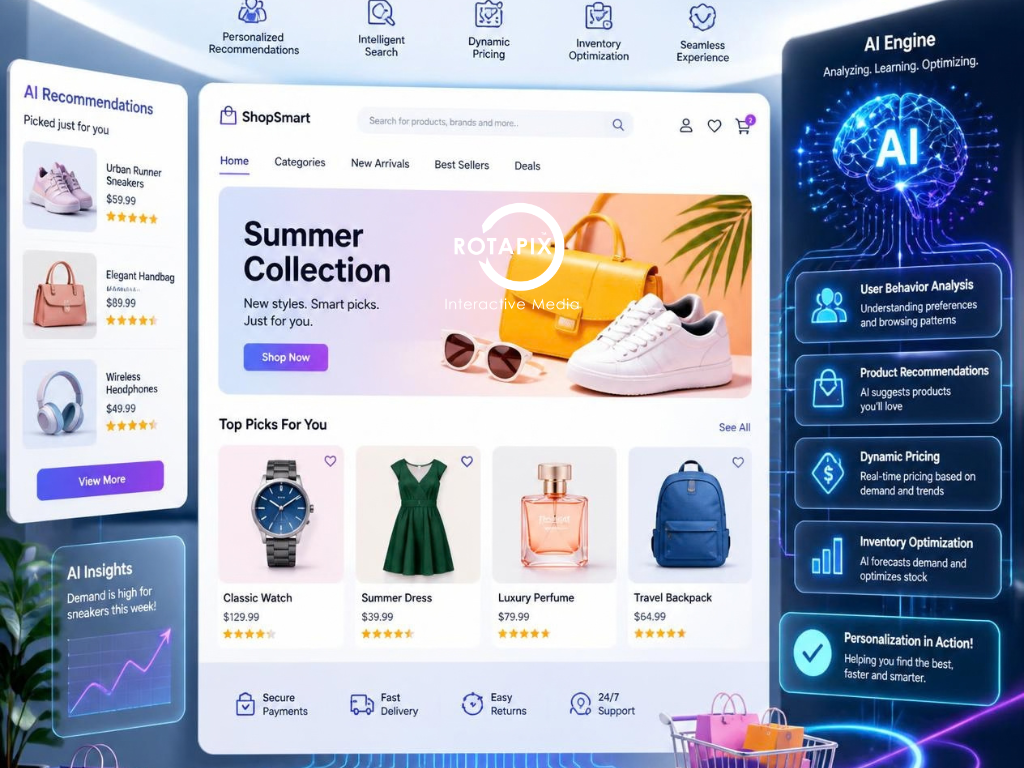
AI ecommerce integration can help online retailers connect artificial intelligence with product data, inventory, customer service, CRM systems and internal business processes. Instead of treating AI as a separate tool, an integrated approach can allow approved systems to exchange information and trigger useful actions across the ecommerce workflow.
The goal is not to automate every decision. A stronger approach is to identify repetitive tasks, define which information AI is allowed to use, decide which actions can happen automatically and keep people involved where judgement, customer commitments or sensitive decisions are required.
This is becoming increasingly relevant as ecommerce platforms develop deeper support for AI-driven shopping and agentic commerce. Shopify now provides tools that allow AI agents to search products, manage carts and assist with checkout, while BigCommerce has highlighted the growing importance of structured product data for AI-driven discovery.
For Australian ecommerce businesses, ai ecommerce integration is therefore becoming less about adding a chatbot and more about improving how data, systems and people work together.
AI ecommerce integration works best when it starts with a specific operational problem rather than a broad goal to “use more AI”.
Online stores contain many repetitive processes, but not all of them need the same level of automation.
How ai ecommerce integration can reduce repetitive store work
AI ecommerce integration can assist with tasks such as categorizing customer enquiries, preparing product copy, summarizing order information, routing support requests and generating internal notifications.
For example, an incoming customer question could be analyzed and classified before being sent to the appropriate support queue.
A product data update could trigger a draft description for review.
An internal workflow could also notify staff when information is missing from a product record or when an inquiry requires attention.
The useful part is not simply generating text. It is connecting AI with an existing business process so staff spend less time repeating the same administrative steps.
Where ai ecommerce integration should keep human oversight
AI ecommerce integration should still keep human approval around higher-risk decisions.
Refunds, pricing changes, product claims, complaints and sensitive customer matters often require judgement.
AI can prepare information and suggest actions, but the business should decide where automation stops.
This creates a more controlled workflow.
Low-risk administrative steps can move faster, while staff remain responsible for decisions that could affect the customer, the business or legal obligations.
Connect Product and Inventory Information
AI ecommerce integration depends heavily on the quality of product and inventory information available to connected systems.
AI cannot reliably work with information that is incomplete, inconsistent or outdated.
How ai ecommerce integration can use product and stock data
AI ecommerce integration can use approved product information such as titles, descriptions, categories, variants, pricing and availability.
This information may support search, recommendations, customer service or internal workflows.
Shopping’s current Admin API allows authorized applications to read and write store data including products, orders, customers and inventory. That makes it possible for ecommerce integration to work with structured store information when the correct authentication and permissions are in place.
The important point is that the integration should retrieve information from the appropriate source rather than rely on outdated copies.
If availability changes frequently, for example, customer-facing AI should not make promises based on stale inventory data.
Why ai ecommerce integration depends on clean product data
AI ecommerce integration becomes more useful when product attributes are clear and consistent.
Product names, categories, colors, sizes, materials, specifications and variant relationships all help AI systems understand what is being sold.
This matters even more as AI-based product discovery grows.
BigCommerce reported in March 2026 that many ecommerce businesses were still working to standardize product pages for agentic AI, highlighting product data readiness as an ongoing challenge.
Clean product data therefore supports more than internal organization.
It can also help make products easier for emerging AI shopping systems to understand and compare.
Improve Customer Service With AI Ecommerce Integration

AI ecommerce integration can support customer service teams by helping them process routine enquiries more efficiently.
This does not necessarily mean replacing customer service staff.
The stronger use case is often to help employees reach relevant information faster.
How ai ecommerce integration can support customer enquiries
AI ecommerce integration can classify incoming questions and identify whether the customer is asking about an order, product, return, delivery or another issue.
If the required information is available through an approved connection, the system may retrieve the relevant context and prepare a response.
Shopify now provides Customer Accounts MCP capabilities designed for authenticated customer requests such as checking order status, retrieving order details and managing account information.
A well-designed workflow can therefore help reduce unnecessary manual searching.
More complex questions can still be escalated to staff with the relevant context already prepared.
How ai ecommerce integration can work with ai agents
AI ecommerce integration can also support ai agents that perform defined actions rather than simply answer questions.
An ai agent may be able to search product information, retrieve approved customer information or trigger a workflow using connected tools.
The important word is defined.
AI agents should not receive unlimited control over store systems.
They should be given specific tools and permissions that match the task they are expected to perform.
This approach is increasingly visible in ecommerce platforms. Shopify now supports agentic shopping functions covering discovery, carts and checkout, while maintaining points where the buyer takes control when confirmation or authentication is required.
For businesses exploring ai agents australia, this creates practical opportunities, but it also makes permission design and workflow governance more important.
Automate Product Content Without Losing Control
AI ecommerce integration can help businesses create and update product content, particularly when large catalogues require frequent changes.
However, automation should not come at the expense of accuracy.
How ai ecommerce integration can assist product content creation
AI ecommerce integration can help prepare product descriptions, FAQs, category copy and internal content drafts based on approved source information.
For example, structured product attributes could be used to produce a first draft of a description.
That draft should still be reviewed where product claims, technical specifications or compliance-related details are involved.
AI should not invent missing specifications.
If the underlying product data does not support a claim, the content should not present it as fact.
This is especially important in ecommerce because inaccurate product information can affect purchasing decisions.
How ai ecommerce integration supports generative engine optimization
AI ecommerce integration can also support generative engine optimization by making product information easier for AI-driven search and discovery systems to interpret.
Generative engine optimization is still an evolving field, but the practical foundation is familiar.
Clear product names, structured attributes, accurate descriptions, accessible pages and consistent information all make content easier for machines and people to understand.
BigCommerce has noted that AI-driven product discovery increasingly depends on structured product data and machine-readable information, not just traditional search optimization.
This means businesses should not treat generative engine optimization as a shortcut involving more AI-generated copy.
The stronger foundation is trustworthy product information.
Connect CRM and Internal Ecommerce Processes

AI ecommerce integration can provide more value when the online store does not operate as an isolated system.
Customer service, CRM, fulfilment and internal administration often depend on information moving between platforms.
How ai ecommerce integration can create a connected ai workflow
AI ecommerce integration can support an ai workflow where information moves between the ecommerce platform and other business systems.
For example, a customer inquiry may begin on the online store, create or update a CRM record and generate a follow-up task.
An order issue may trigger an internal notification and prepare relevant information for the support team.
The important part is deciding which platform owns each piece of information.
The ecommerce platform may remain the source of truth for product and order data, while the CRM may manage sales relationships and communication history.
The ai workflow should connect those systems without creating unnecessary duplicate data.
How ai ecommerce integration can use ai agents frameworks
AI ecommerce integration can also benefit from ai agents frameworks that define how agents use tools, make requests and move between tasks.
The framework itself is less important than the controls around it.
Businesses should know which tools the agent can access, what data those tools expose and which actions require confirmation.
Modern commerce platforms are moving towards this tool-based model.
Shopping’s agentic commerce documentation separates product discovery, carts, checkout and account functions into distinct capabilities, creating clearer boundaries around what an agent can do.
This is a useful principle even when a business uses a different ecommerce platform.
Give the AI access to the functions it needs, not the entire environment.
Extend AI Ecommerce Integration Into Emerging Experiences
AI ecommerce integration does not need to stop at back-office automation.
It may also support new customer experiences when there is a clear reason to connect those experiences with product and store information.
How ai ecommerce integration can support augmented reality in e-commerce
AI ecommerce integration may complement augmented reality in e-commerce where customers benefit from visualizing a product before purchase.
AR can be useful for categories where size, appearance, placement or configuration influences the buying decision.
The AI layer may help guide customers towards relevant products, while the AR experience helps them visualize those products.
However, augmented reality in e-commerce should not be added simply because the technology is available.
The experience needs to solve a genuine customer problem.
If a normal product image and clear dimensions answer the question more efficiently, AR may add complexity without enough value.
How ai ecommerce integration can connect with ar ecommerce
AI ecommerce integration can support ar ecommerce by connecting product attributes, variants and customer-facing information with the AR experience.
For example, the system needs accurate product dimensions, color options or model information if the user is expected to visualize a specific item.
That means AR still depends on strong ecommerce data.
The same principle applies to AI recommendations.
If product attributes are inconsistent, the customer may be shown the wrong configuration or receive an unsuitable recommendation.
An effective ar ecommerce experience therefore starts with reliable catalogue information before advanced visual technology is added.
Build a Safer AI Ecommerce Integration Strategy

AI ecommerce integration should be treated as an ongoing business capability rather than a single software installation.
The safest approach is usually to start with a narrow workflow, measure how well it works and expand gradually.
How ai ecommerce integration should be planned for Australian businesses
AI ecommerce integration for Australian businesses should consider customer information, permissions, system security and consumer obligations.
Businesses should also be careful about the accuracy of product information and customer-facing AI responses.
The ACCC continues to focus on online product safety and the responsibilities of digital marketplaces, reinforcing the importance of reliable ecommerce information and processes.
AI does not remove those responsibilities.
If an automated system gives incorrect information about a product, the fact that AI generated the response does not make the customer impact disappear.
Businesses exploring ai agents australia should therefore define what agents may say, which systems they can access and when they must escalate to a person.
How ai ecommerce integration can scale without adding complexity
AI ecommerce integration does not need to begin with a large transformation project.
A business can start with one clear ai workflow.
That might be customer inquiry classification, product content assistance or internal order summaries.
Once the workflow is stable, the business can review whether the automation is reducing manual work without creating new errors.
From there, further systems can be connected gradually.
Rotapix can be relevant for businesses reviewing where AI fits within ecommerce workflows, particularly where existing websites, ecommerce systems and connected business applications need to work together.
The strongest approach is to automate only where the outcome is clear.
AI agents, generative engine optimization, augmented reality in e-commerce and other emerging technologies can all play a role, but they should build on reliable product data, controlled system access and practical business processes.
AI ecommerce integration works best when it makes those processes simpler rather than adding another layer of complexity.