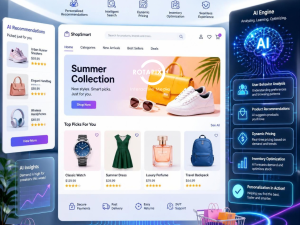
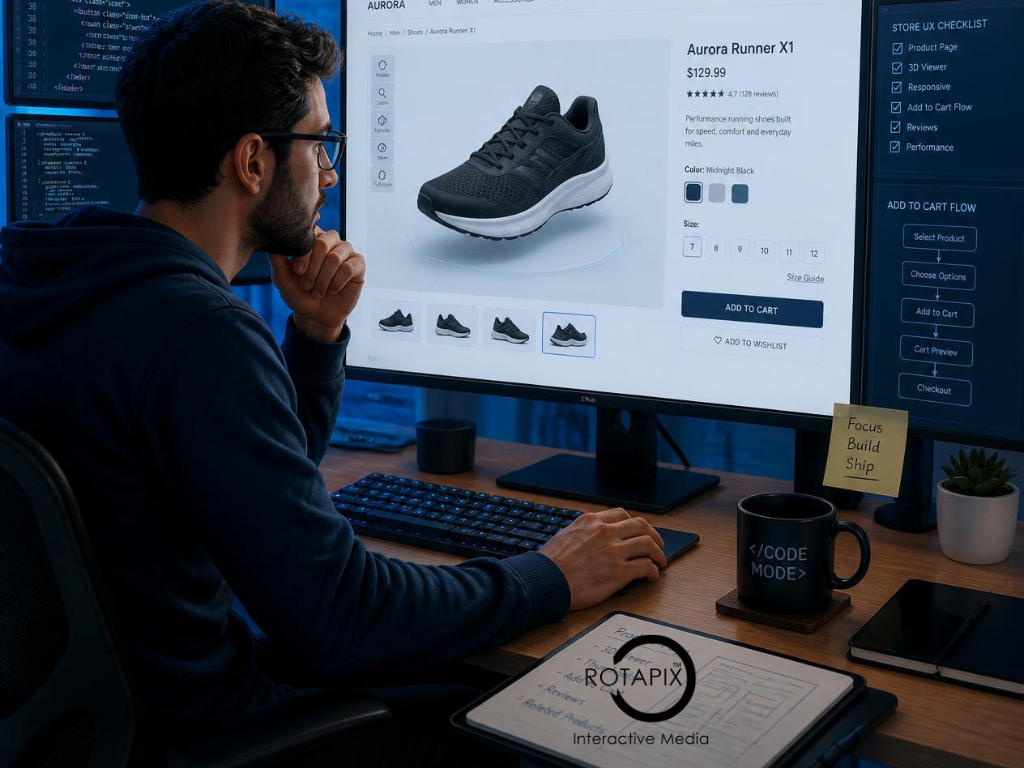
AR ecommerce gives online shoppers a way to explore products beyond conventional photographs and descriptions. Using augmented reality technology, customers may be able to see how furniture looks in their home, examine products from different angles or virtually try selected items before purchasing.
For Australian small retailers, the technology presents an interesting opportunity. Online customers cannot always examine a product physically, making it difficult to judge its appearance, dimensions or suitability. Augmented reality can provide additional visual information that helps some shoppers make more informed decisions.
However, introducing AR involves more than adding an interactive feature to an online store. Retailers may need suitable 3D product models, compatible software, website integration, mobile testing and ongoing technical support.
These requirements create costs that must be compared with the potential benefits.
A business selling a small range of furniture may have different needs from a retailer managing hundreds of clothing products. Similarly, a store with excellent product photography and straightforward purchasing decisions may gain less practical value from AR than one selling products that customers regularly struggle to visualize.
Before investing, retailers should understand what augmented reality can realistically achieve, how much work implementation involves and whether customers are likely to use the experience.
How AR Ecommerce Works for Online Shopping
Augmented reality combines digital content with a view of the physical environment.
For online shopping, this commonly involves using a compatible smartphone or tablet to display a virtual product through the device’s camera.
For example, someone considering a coffee table may be able to position a digital representation of the table within their living room.
The experience can help the customer visualize how the product might look alongside existing furniture.
However, not every interactive product experience is augmented reality.
A standard 3D product viewer allows customers to rotate, zoom in on or examine a digital product model directly on the screen.
An AR product viewer goes further by attempting to position that model within a real-world environment.
Virtual try-on experiences are another variation. Depending on the technology, they may use a camera to position digital eyewear, accessories or other items in relation to the customer’s appearance.
The accuracy of these experiences varies according to the device, product model and tracking technology.
For Australian retailers considering augmented reality in e-commerce, understanding these differences is important because each experience involves different technical requirements.
A rotating 3D model may provide enough information for some products without requiring the complexity of camera-based AR.
The right solution depends on what the customer needs to understand before purchasing.
When Does AR Ecommerce Make Financial Sense?
AR ecommerce is most likely to be worth considering when visual uncertainty is a meaningful obstacle to purchasing.
A customer buying a large decorative item may wonder whether it will suit an existing room.
Someone considering a product with unfamiliar proportions may benefit from seeing an approximate representation of its dimensions.
In these situations, augmented reality can provide information that conventional images may struggle to communicate.
However, AR does not necessarily add equal value to every product.
A retailer selling straightforward replacement parts, everyday consumables or standardized products may find that accurate specifications, clear photographs and detailed descriptions meet customer needs more efficiently.
Before investing, business owners should consider what questions customers ask most frequently.
Do customers regularly enquire about product size, appearance or placement? Are products returned because they look different from what shoppers expected? Would interactive visualization address those concerns?
The answers can help determine whether AR solves an existing problem or simply introduces another feature.
Retailers should also assess the quality of their current online store.
If product descriptions are incomplete, navigation is confusing or checkout problems are affecting purchases, resolving those issues may be a more sensible first investment.
AR should support an effective shopping experience rather than compensate for basic website problems.
Understanding the Real Costs of Augmented Reality
The cost of AR ecommerce depends on the products being displayed, the technology selected and the amount of development required.
Unlike ordinary product photography, augmented reality may require digital assets that reproduce a product’s shape, dimensions, materials and appearance in three dimensions.
Creating these assets can involve specialist work, particularly when products have detailed surfaces or numerous variations.
The total cost should also include how the models will be displayed, maintained and updated as the product catalogue changes.
What Influences AR Ecommerce Development Costs?
One of the most important cost factors is the creation of suitable 3D product models.
Some products can be represented using relatively simple geometry and textures.
Others require more detailed modeling to reproduce distinctive shapes, transparent materials, reflective surfaces or complex components.
A basic side table may be easier to model than a detailed upholstered chair with multiple fabric options and intricate construction.
The number of products also matters.
Developing an AR experience for five selected items involves a different amount of content preparation from preparing hundreds of products.
Retailers should consider product variations as well.
If an item is available in several finishes, sizes or configurations, each variation may require additional modeling, texture work or integration.
The eCommerce platform can influence development requirements.
Some platforms support compatible 3D product media through existing features or themes, while others may require third-party applications or custom integration.
A retailer may also want additional functionality such as changing product colors within the AR viewer, switching between configurations or integrating visualization with a product configuration.
These requirements can increase development complexity.
Testing is another important cost component.
The experience should be reviewed on different devices, browsers and screen sizes to identify compatibility and usability problems.
Rather than relying on a generic AR development price, businesses should request an itemized proposal based on their products, platform and intended customer experience.
Hidden Expenses: 3D Models, Updates and Maintenance
The initial implementation cost is only part of the financial commitment.
Once AR functionality is available, retailers need to consider what happens when products change.
New catalogue items may require additional digital models.
Changes to product dimensions, materials or colors may require existing models to be updated.
If inaccurate models remain online, customers may receive misleading information about the items they are considering.
Third-party applications can also involve subscription fees, usage allowances or charges linked to features and catalogue size.
Retailers should confirm how these costs are calculated before choosing a service.
Ongoing website maintenance may be necessary as browsers, operating systems and eCommerce platforms change.
An AR feature that works correctly when launched should continue to be tested after relevant platform or software updates.
Product model storage, content management and hosting requirements may also affect the long-term cost.
Businesses should understand who owns the original 3D files and whether they can reuse those assets with another provider or platform.
It is particularly important to distinguish access to a hosted viewing service from ownership of the underlying models.
A retailer may be able to display models through a subscription without necessarily owning all the source files used to create them.
Before committing, ask how future updates will be handled and whether there are additional charges for adding products, modifying models or changing platforms.
A realistic budget should reflect the complete lifecycle of the AR experience rather than the installation price alone.
Choosing the Right Products for AR Shopping

Product selection can determine whether AR ecommerce provides genuine value for a small retailer.
Augmented reality is most useful when customers benefit from understanding how an item looks, fits or occupies space.
Businesses should therefore consider the buying decisions associated with their products before deciding how many items need AR functionality.
Which Products Benefit Most From AR Ecommerce?
Furniture and home décor are practical examples of product categories where augmented reality may help shoppers.
A customer considering a sofa, cabinet or floor lamp may want to understand its approximate size and appearance within an existing room.
A virtual product preview can provide additional context.
However, accurate measurements remain essential because camera positioning and virtual scaling may not perfectly reproduce real-world conditions.
Products such as eyewear and selected accessories may also suit virtual try-on experiences.
These applications can help customers explore style and appearance, although they may not provide a reliable assessment of physical comfort or precise fit.
For clothing, the technology can be more complex.
A convincing representation may need to account for different body shapes, garment movement and fabric behavior.
A basic visual overlay should not be presented as an accurate fitting system unless the technology genuinely supports that purpose.
Other products may benefit from interactive 3D viewing rather than full augmented reality.
For example, a customer examining a detailed piece of equipment may want to rotate the model and inspect components from different angles.
In this situation, a conventional 3D viewer may provide the required information without placing the product in a camera view.
Retailers should also consider product price and purchasing complexity.
Customers may be more willing to spend time examining a high-consideration purchase than a low-cost everyday item.
The strongest candidates are products where visualization answers a meaningful question that existing photographs, dimensions and descriptions do not fully address.
Why Starting With a Small Product Range Can Be Smarter
Introducing AR across an entire catalogue may create unnecessary costs before a retailer understands whether customers will use it.
A smaller pilot allows the business to test both the technology and the shopping experience.
For example, a home furnishing retailer might begin with a limited range of frequently viewed products that customers regularly ask about.
The selection should be based on customer needs rather than choosing items simply because they are easy to model.
The retailer can then assess how customers interact with the feature.
Do visitors activate the viewer? Can they position the product successfully? Do they understand what the visualization represents?
Customer feedback may reveal issues that technical testing does not identify.
Some shoppers may find the controls confusing, while others may appreciate being able to examine the item from different angles.
A pilot also helps the business understand the effort required to maintain models and support customers.
If adding each new product creates significant work, the retailer can refine the process before expanding.
Starting with a small range does not mean the technology will necessarily succeed.
It provides a practical way to evaluate costs, usability and customer interest while limiting the initial commitment.
The findings can help determine whether to expand AR, improve the experience or direct the budget towards other website improvements.
Comparing AR Ecommerce Platforms and Development Options
Choosing a suitable platform is an important part of planning AR ecommerce because not every online store supports 3D and augmented reality features in the same way.
Businesses should review their existing eCommerce environment before purchasing a separate application or commissioning custom development.
The most appropriate option depends on platform compatibility, product requirements, available features and the level of control needed over the customer experience.
Shopify Developer vs BigCommerce Developer for AR Features
Shopify provides support for compatible 3D product models as part of its product media functionality.
Retailers can use supported model files, subject to platform requirements, and display them through compatible themes.
Shopify’s documentation identifies GLB and USDZ as supported 3D model formats.
However, retailers should confirm that their selected theme and storefront configuration support the intended viewing experience.
A Shopify Developer may help configure product media, adjust theme functionality or integrate a suitable application when the standard features do not meet the retailer’s requirements.
BigCommerce provides a different development environment, with options for extending storefront functionality through compatible applications, APIs and custom development.
Retailers considering AR on BigCommerce should investigate which capabilities are available through their actual storefront setup.
A Big Commerce Developer may be able to assist with integrating a compatible 3D viewer, connecting external product visualization software or developing customized storefront functionality.
However, the level of integration depends on the selected technology and should be confirmed before development begins.
Businesses should not assume that Shopify and BigCommerce provide identical native AR capabilities.
The platforms differ in their technical environments, themes, integration and implementation methods.
A retailer already operating a reliable online store should consider whether AR can be introduced without migrating to another platform.
Changing the entire eCommerce system solely to introduce augmented reality may create unnecessary expenses involving product migration, payment configuration, integration and staff training.
A platform comparison should therefore consider the complete business operation, not only the AR feature.
Ready-Made AR Applications vs Custom Web Development
Ready-made AR applications may offer a more straightforward starting point for retailers with common product visualization requirements.
Depending on the application, the business may be able to upload compatible models, configure product viewers and display AR functionality without building the entire system from scratch.
This can reduce initial development requirements.
However, retailers should confirm the application’s compatibility with their eCommerce platform and existing theme.
They should also understand its subscription arrangements, supported devices and limitations.
Custom Web Development becomes more relevant when the intended shopping experience requires functionality that standard tools cannot provide.
For example, a retailer may need a specialized product configuration, custom interaction controls or an integration with internal product data.
These requirements may justify a tailored solution.
However, custom development also involves additional design, testing, documentation and maintenance responsibilities.
The decision should be based on the capabilities required rather than assuming custom technology is always better.
Retailers should also distinguish AR from artificial intelligence.
AI ecommerce integration may support activities such as personalized recommendations, automated customer assistance or selected product content workflows.
These functions are separate from the core technology used to position a virtual product in a physical environment.
Some projects may combine AI and AR, but AI is not a requirement for every augmented reality shopping experience.
The most suitable development approach is the one that provides the necessary functionality without introducing unnecessary complexity.
Designing AR Experiences That Customers Can Actually Use
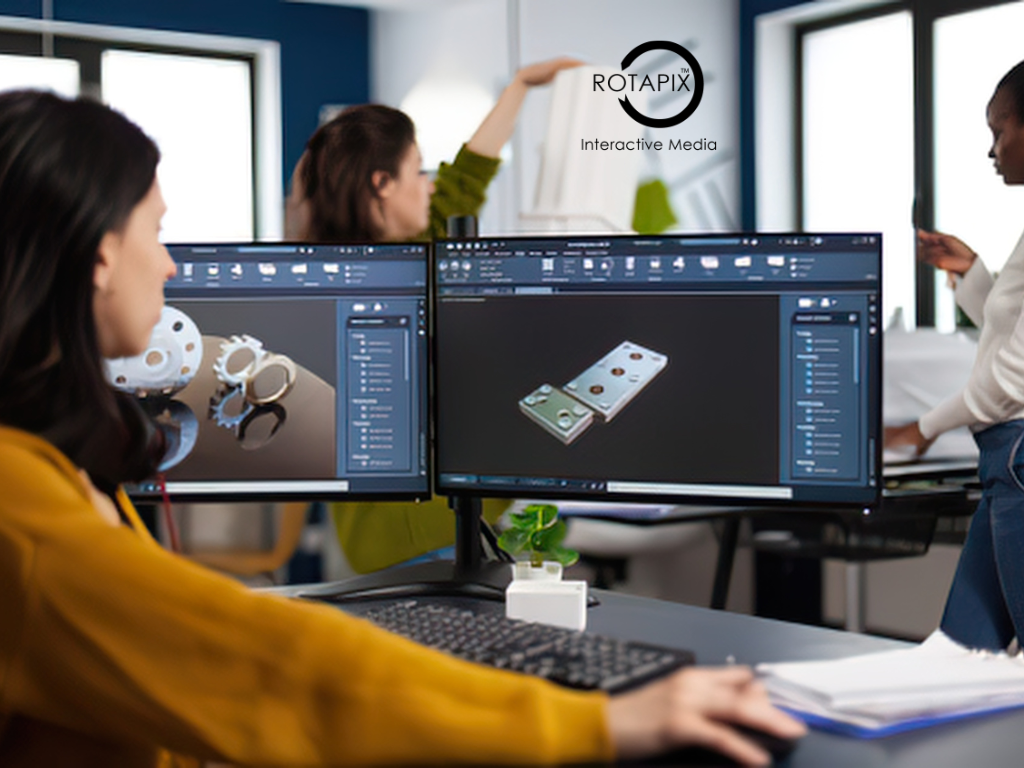
Even a technically sophisticated AR ecommerce feature provides limited value if customers struggle to understand how it works.
A useful experience should make product visualization straightforward and avoid interrupting the purchasing process.
For small retailers, this means placing usability ahead of unnecessary visual effects.
How UI UX Design Improves AR Shopping Experiences
UI UX Design influences how shoppers discover, activate and interact with augmented reality features.
Customers should be able to recognize when a product offers AR viewing and understand what will happen when they select the feature.
For example, a product page might provide a clearly labeled option to view an item in the customer’s room.
The interface should explain what the customer needs to do next, particularly when camera access or device movement is required.
Instructions should be brief, understandable and relevant to the action.
Once the virtual product appears, customers may need controls for repositioning, rotating or adjusting its placement.
These controls should be easy to identify and use.
The experience should also provide an obvious way to return to the standard product page.
Customers should not have to restart the shopping process after exploring a model.
Product information should remain accessible through conventional page content.
A customer may still need to check dimensions, color options, materials, delivery information and pricing.
AR should enhance these details rather than replace them.
Retailers should test whether the feature helps customers answer practical questions.
If customers frequently struggle to position a product or understand the scale, the experience may need better instructions or improved interaction design.
Good UI UX Design reduces unnecessary effort and helps shoppers remain focused on choosing a suitable product.
Mobile Compatibility, Loading Speed and Accessibility
Many augmented reality shopping experiences rely on mobile device capabilities.
However, support varies across browsers, operating systems, hardware and the selected AR technology.
A feature that works on one smartphone may behave differently or be unavailable on another.
Retailers should verify device compatibility and explain limitations where necessary.
Camera permissions can also affect the experience.
Some customers may prefer not to provide camera access, while others may use devices that do not support the required features.
For these customers, the website should continue to provide conventional product photographs, descriptions and measurements.
A standard 3D viewer may also be an appropriate alternative where supported.
Model loading performance is another important consideration.
Detailed digital models can require substantial data, particularly when they contain complex geometry and high-resolution textures.
Large files may take longer to load on slower mobile connections.
The model should therefore be optimized without removing important visual details needed to represent the product accurately.
Retailers should also consider visitors who rely on keyboard navigation, assistive technologies or alternative interaction methods.
Not every AR experience can provide an equivalent visual interaction for every user, but essential product information and purchasing functions should remain accessible outside the AR interface.
Testing should include realistic conditions rather than only powerful development devices.
An AR feature should be judged by how reliably customers can use it, not merely whether it looks impressive during a demonstration.
Measuring Whether AR Ecommerce Delivers Business Value
After introducing AR ecommerce, retailers need to determine whether the feature addresses the customer problem it was intended to solve.
The number of people who activate AR can provide useful information, but engagement alone does not establish financial value.
A meaningful assessment should connect customer behavior with development costs, operational requirements and purchasing outcomes.
Tracking AR Ecommerce Engagement and Customer Behavior
Retailers should identify what they want to measure before launching AR.
For example, the purpose may be to help customers understand product dimensions, improve product information or reduce uncertainty before purchasing.
Website analytics can be configured to record relevant interactions.
These might include customers opening an AR viewer, spending time with the experience and returning to the product page.
Retailers may also examine whether customers who use AR subsequently add products to their cart or complete purchases.
However, these behaviors require careful interpretation.
Customers who choose to activate AR may already be more interested in a product than visitors who do not.
If AR users purchase more frequently, the difference does not automatically prove that AR caused the increase.
The retailer should also consider how often the feature fails or is abandoned.
Technical errors, long loading times and unclear instructions may reduce participation.
Customer feedback can provide useful context.
For example, shoppers may report that AR helped them understand the size of a product but that the color representation was not sufficiently accurate.
This information can guide improvements to the models or instructions.
Businesses should avoid relying solely on broad engagement metrics.
The most relevant measures are those that help determine whether the feature improves the shopping experience and supports the intended business outcome.
Comparing Implementation Costs With Sales and Returns
The financial value of AR depends on both its costs and any measurable benefits.
Retailers should consider the initial cost of creating models and integrating the technology, together with continuing expenses such as subscriptions, maintenance and catalogue updates.
These costs can then be compared with relevant business outcomes.
For example, a retailer may want to know whether customers make fewer enquiries about product dimensions after AR is introduced.
Another may want to examine whether particular products experience fewer returns associated with unexpected size or appearance.
Return data should be interpreted carefully.
Products can be returned for many reasons, including damage, delivery problems, changes of mind and differences between expectations and actual product characteristics.
AR is not designed to resolve every cause.
It is also important to recognize that customer behavior may change because of factors unrelated to the technology.
Advertising campaigns, seasonal demand, discounts and product availability can all affect sales.
Where practical, businesses can compare appropriate product groups or time periods while accounting for these differences.
A retailer working with a digital marketing agency may also review conversion tracking and customer behavior to understand whether the feature contributes to broader marketing objectives.
However, reporting should distinguish between observed patterns and evidence that demonstrates a direct effect.
If the results do not justify the investment, the business may decide to refine the experience, limit it to selected products or discontinue further expansion.
A successful evaluation is one that supports an informed business decision, even when the outcome is not to invest more.
Making the Right AR Investment for Your Online Store

For small retailers, the best AR ecommerce strategy is not necessarily the most advanced implementation.
It is the approach that addresses a genuine customer need while remaining practical to develop, manage and maintain.
Before selecting a provider, businesses should define what customers need help understanding and how augmented reality might improve that process.
Questions to Ask an AR Ecommerce Development Provider
A development provider should first understand the retailer’s products, existing website and business objectives.
Before recommending technology, the provider should establish whether AR offers a meaningful advantage over standard product photography or interactive 3D models.
Retailers should ask how suitable products will be selected and how the required digital models will be created.
The discussion should cover model accuracy, product variations, material representation and future updates.
Compatibility is equally important.
The provider should explain which mobile devices, browsers and eCommerce environments will support the proposed experience.
If the business operates on Shopify or BigCommerce, the provider should identify whether the implementation relies on existing platform capabilities, third-party software or custom development.
Retailers should also clarify who owns the finished models, whether source files will be supplied and what happens if the business changes providers.
The project proposal should explain testing responsibilities, ongoing maintenance and any recurring software costs.
It should also identify how the experience will be evaluated after launch.
Providers should be willing to explain limitations, including device support, visual accuracy and the fact that AR cannot guarantee increased sales or fewer returns.
A realistic discussion of these issues is more useful than a presentation focused entirely on the novelty of the technology.
Planning a Practical AR Ecommerce Implementation
A sensible implementation begins with identifying suitable products and establishing what customers need from the experience.
The next step is reviewing the existing eCommerce platform and deciding whether an available application, built-in media functionality or custom development is appropriate.
Once the technical approach is understood, businesses can obtain realistic estimates for model creation, integration, testing and ongoing support.
A limited pilot may help determine whether the proposed solution is worth expanding.
For Australian retailers considering professional assistance, Rotapix provides digital development services that include augmented reality in e-commerce, website development and interactive user experiences.
Its Augmented Reality in E-Commerce service covers virtual product visualization, 3D product examination and interactive catalogue experiences.
The company’s Web Solutions services also include Shopify, BigCommerce, custom web applications, UI/UX Design and AI integration.
These capabilities may be relevant to retailers comparing standard AR integration with more tailored shopping experiences.
However, businesses should still confirm the scope of their project, supported platforms, model requirements and ongoing costs before proceeding.
If you are considering AR for your online store, you can contact Rotapix to discuss your product range, existing platform and the type of shopping experience you want to provide.
Augmented reality can be useful when it helps customers understand products they cannot physically inspect before purchasing.
For other products, conventional photographs, accurate specifications and a well-designed online store may provide better value.
The most practical decision is to invest in AR when its benefits are relevant to your customers, its limitations are understood and the expected value justifies the full cost of implementation and maintenance.